Category: AI

  • When AI Search Gets Your Business Wrong: Find the Conflicting Signals

    When AI Search Gets Your Business Wrong: Find the Conflicting Signals

    A business not showing in ChatGPT is one problem. A worse one is appearing with the wrong service, an old location, a thin description, or a version of the company that stopped being accurate months ago.

    Publishing another blog post will not automatically fix that.

    The business already has a public record spread across its own pages, search profiles, review sites, directories, old URLs, and structured data. If those sources disagree, the first job is to find the conflict before adding more content.

    BrandLyft’s LLM Search / AI SEO work starts from that foundation. The business needs clear facts that people can verify and machines can interpret without reconstructing the company from fragments.

    Find the Wrong Answer Before You Fix the Website

    Start with the actual output.

    Ask the same business question in several forms. Search the company name first. Then ask what the company does and which areas it serves. Test the service that matters most. Try a category query a customer might use when comparing providers.

    Save the answer and the cited sources when the tool provides them.

    Do not begin by changing every page that mentions the business. First identify the specific fact that is wrong, missing, or unstable. A wrong location is a different problem from a missing service. An old company description has a different trail from a competitor earning citations for a question your own site barely answers.

    The source list matters too. ChatGPT search can surface public websites and cite web sources when answering current questions. OpenAI also says public sites can appear in ChatGPT search when site owners allow OAI-SearchBot to access the content needed for summaries and snippets.

    That does not mean allowing a crawler guarantees a mention. It means a correction cannot help a search system that cannot access the corrected page.

    A Business Not Showing in ChatGPT May Have a Definition Problem

    A company can describe itself in several ways without noticing the gaps.

    The homepage calls it a restoration company. Service pages say water damage and mold remediation. An outdated About page still describes a general construction business. One location page focuses on roofing because that office offered it years ago. Google Business Profile uses another category. An old directory calls the company a remodeling contractor.

    A person can often infer that the business changed over time. Those pages and profiles can remain available as separate public sources long after the business has moved on.

    The fix is not to repeat one sentence everywhere.

    Write down the current facts first. Use the exact business name people should recognize today. List the services the company actually sells and the locations that are real. Add the service areas the company supports, the type of customer it serves, and any old offers that have ended.

    Those facts need to stay stable even when the wording changes from page to page.

    Google’s current Organization structured-data guidance makes the same distinction at a technical level. Organization markup can identify details such as the company name, URL, phone number, address, logo, and external profiles. The markup helps only when those details describe the same organization people can see on the site.

    Service Names Can Drift Without Looking Wrong

    Service naming causes quieter problems.

    A company might use “water restoration” on the homepage, “water damage restoration” on the main service page, “emergency water extraction” on a location page, and “flood cleanup” in an old article. Those terms may overlap, but they do not always mean the same service.

    Variation is normal. Unclear boundaries are the problem.

    The main service page should say what the company actually offers, who it serves, and any meaningful boundary around that service. Supporting pages can use natural variations without making the offer look like four unrelated businesses.

    Watch for renamed services. A business may stop using an older label while the old page keeps ranking, receiving links, or appearing in search. Deleting the phrase from the navigation does not remove the old URL from the public record.

    If the old service still exists under a new name, update the page and its internal links. If the offer is gone, decide whether the URL should redirect, remain for a valid historical reason, or leave the index. Do not let an abandoned page keep describing the company by accident.

    Location Conflicts Are Easy to Create and Expensive to Ignore

    Location information can drift after a move, expansion, franchise change, or service-area update.

    The footer may show headquarters. Contact pages may show several branches. Location pages can contain old phone numbers. An About page may mention the city where the company started. Review profiles and directories may still display a previous address.

    None of those facts is automatically wrong. The problem appears when a customer cannot tell what each location means.

    A service business with one office and a wide service area should not make every city sound like a physical branch. A multi-location company should give each real location a stable name, address, phone number, and page when appropriate. Service-area language should describe where the company works without manufacturing offices that do not exist.

    Google’s LocalBusiness documentation supports location-specific business details and recommends defining individual locations when a business has distinct physical locations. That markup should reinforce the visible page, not create a second version of the location.

    If an AI answer names the wrong city, inspect the website before blaming the model. Check the contact page, location pages, footer, structured data, external profiles, old press mentions, and any indexed page that still pairs the brand with the outdated place.

    The About Page Is Part of the Business Record

    Many service-business About pages say almost nothing that another source can verify.

    “Family owned.” “Customer focused.” “Quality service.” “Years of experience.”

    None of that clearly identifies the company.

    A useful About page should explain the business in plain terms. Name the company. State what it does. Show where it operates. Introduce real people when that supports trust. Mention meaningful history without leaving old positioning uncorrected. Link toward the services and locations that carry the detailed information.

    Proof needs the same treatment.

    A service page can claim commercial expertise while every case study shows residential work. The homepage can advertise a specialty that never appears in reviews, project examples, team information, or supporting content. That does not make the service false, but it leaves the website asking the reader to take the claim on faith.

    BrandLyft’s AI SEO and LLM Search service focuses on this kind of entity and trust clarity rather than treating AI visibility as a keyword-count problem.

    Do Not Let Structured Data Tell a Different Story

    Structured data can clarify a page. It should not become a hidden correction layer for weak or outdated visible content.

    Google’s structured-data guidelines say the markup should represent content visible to readers and should stay up to date. Organization markup can also help Google disambiguate a company and connect administrative details with its online presence.

    That makes schema a useful audit point.

    Compare the visible business name, phone number, address, URL, logo, organization type, and location details with the structured data actually rendered on the site. Check whether old plugins left duplicate Organization or LocalBusiness entities behind. Look for a previous address, retired social profile, old company name, or service type that the visible page no longer supports.

    Fix the public page and the markup together.

    Adding more schema properties will not repair a page that still gives the wrong answer in plain English.

    AI Search Fact Check

    Fix the business record before adding more content

    BrandLyft’s LLM Search / AI SEO service checks website structure, business information, proof, and machine-readable signals before the team adds more AI-focused content.

    Review LLM Search / AI SEO

    Internal Links Tell Systems Which Pages the Site Treats as Important

    A strong service page can sit almost alone.

    Maybe it appears in the navigation, but no related articles link to it. Location pages mention the service without linking back. The homepage uses a broad “Services” link while the high-value specialty sits three clicks deeper. Older pages point to a retired version instead.

    That weakens the site’s own explanation of what matters.

    Google says it uses links to discover pages and as a relevance signal. Its link guidance also recommends logical site structure and descriptive internal anchor text.

    For this diagnostic, follow the links around the business facts that AI keeps getting wrong.

    If the company wants one page to be the main source for a service, other relevant pages should support that relationship. If a location page owns a specific local fact, the site should not keep sending internal authority toward an older duplicate. The goal is not to flood the site with links. It is to stop treating important pages like isolated documents.

    Old URLs Can Keep an Old Version of the Company Alive

    A redesign does not erase the previous website from the web.

    Old service URLs may still return 200 status codes. Near-duplicate pages can remain indexable after a site rebuild. A former location may still have a page. A staging or alternate path may contain copied content. The current navigation can look clean while crawlers still reach older versions through links, sitemaps, or external references.

    Google’s canonicalization documentation explains that Google may group duplicate or very similar pages and select one representative URL. Site owners can provide canonical signals, but those signals do not replace cleanup when two pages serve different jobs.

    Review old URLs when the wrong AI description sounds suspiciously familiar.

    Search the exact outdated phrase. Check which page still contains it. Inspect redirects, canonicals, sitemaps, and internal links. If the old page has no current purpose, resolve that instead of publishing a new article that says the opposite.

    A correction works better when the old contradiction stops competing for attention.

    External Profiles Should Confirm the Basics

    The company website is the source it controls most directly, but it is not the only public description customers can encounter.

    Google Business Profile, social profiles, review platforms, trade directories, partner pages, local chambers, press coverage, and industry listings may repeat business facts. Some will lag behind after a move, rebrand, acquisition, or change in services.

    Do not try to make every profile use identical marketing copy.

    Confirm the basics instead. The current business name should be recognizable. Real locations should match. The main category should not describe an offer the company dropped years ago. The website URL should point to the correct domain. Service descriptions should not directly contradict the pages customers reach after clicking.

    Google’s Organization schema supports sameAs links to relevant external profiles. That can help identify the organization’s online presence, but it does not make an outdated profile accurate. The profile still needs correction at its source.

    If you cannot edit a third-party listing, document it. Then strengthen the sources the business can control rather than inventing certainty about when an outside site will change.

    Use a Fact Map Before You Publish More AI Content

    When several contradictions appear at once, make the problem small enough to fix.

    Create one working record for the facts that should remain stable across the business’s public presence. This is not a giant brand-message document. Keep it practical.
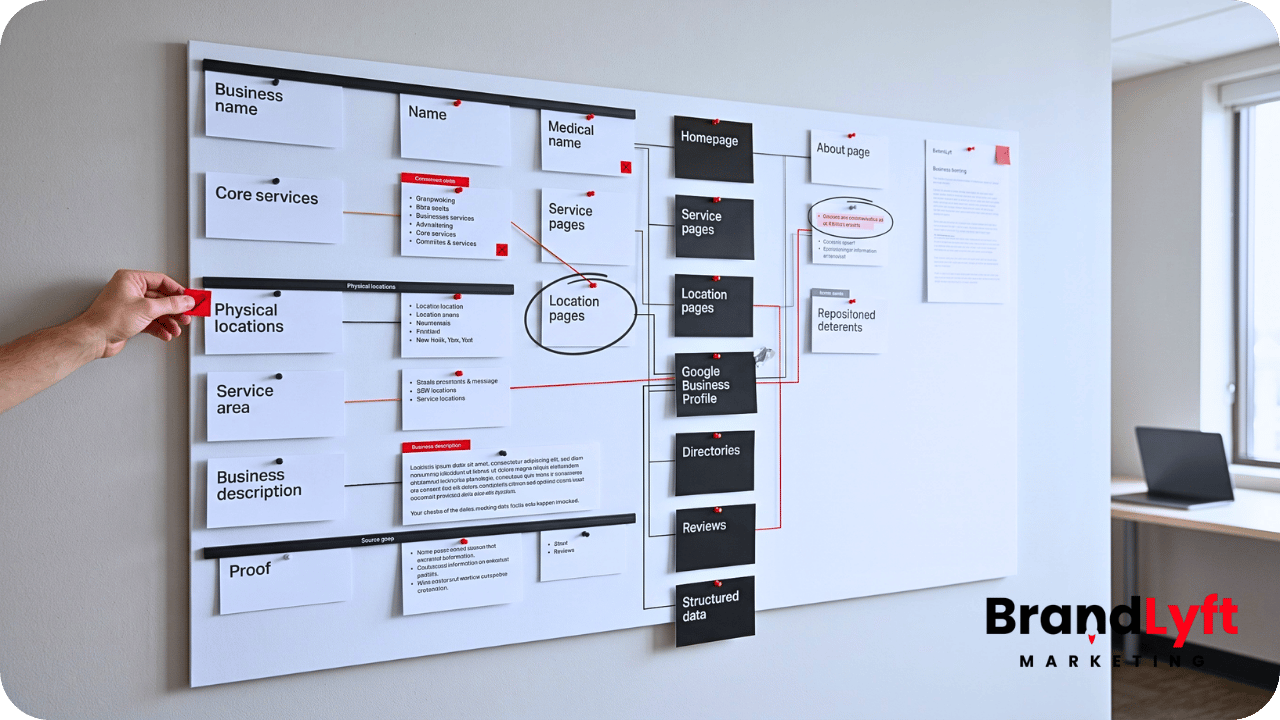
    Wall-mounted business fact map organizing company name, services, locations, and source pages to trace conflicting public information.

    A practical fact map helps businesses trace conflicting public information before publishing more AI-search content.

    Business factPrimary website sourceOther places to verifyCommon conflict
    Business nameHome or About pageProfiles, schema, directoriesOld brand name or inconsistent suffix
    Core servicesMain service pagesHomepage, profiles, reviewsRetired or vague service labels
    Physical locationsLocation and Contact pagesLocal profiles, schemaOld address or fake-looking branch
    Service areaRelevant service/location copyProfiles and local pagesPhysical location confused with coverage area
    Business descriptionAbout pageProfiles, partner pagesPrevious positioning still public
    ProofCase studies, team, reviewsExternal review sourcesClaims unsupported by visible evidence

    Pick the page that should be authoritative for each fact. Fix that page first. Then work outward through the pages and profiles that repeat it.

    This prevents a common reaction to AI visibility problems: publishing five new articles while the homepage, About page, schema, and location information still disagree.

    Test the Correction as a Retrieval Problem

    After the sources change, test again.

    Use the same prompts that exposed the problem. Keep the wording and location context consistent enough to compare the answers. Check the cited sources. Search the corrected fact directly. Inspect whether the updated page is crawlable and indexable.

    OpenAI says sites that want content included in ChatGPT search summaries and snippets should allow OAI-SearchBot. Google offers URL Inspection and a Request Indexing option for updated pages in Search Console. Neither action guarantees an AI answer will change on command.

    Re-crawling, indexing, retrieval, source selection, and answer generation are separate events. A corrected page can exist before a search product has refreshed or selected it.

    Track the test instead of declaring victory after one prompt.

    Record the date, prompt, answer, cited sources, and the exact fact you are checking. Try again after the source changes have had time to propagate. If the wrong answer remains, look at the sources the tool still cites rather than immediately rewriting the correct page again.

    AI Search Visibility Gets Easier to Diagnose When the Business Facts Stop Moving

    A business not showing in ChatGPT does not automatically need more AI content.

    Sometimes the company already has enough pages. The problem is that those pages do not describe the same current business clearly enough, or an older source still carries a version that should have disappeared.

    Start with the wrong fact. Find where it appears. Correct the page that should own it. Bring the nearby website pages, structured data, and public profiles back into agreement where they genuinely conflict.

    Then test again.

    That work also supports normal search and human trust. A customer should not have to decide which address is real, which service name is current, or which version of the company to believe.

    AI search is another place where those inconsistencies become visible.

    AI Search Diagnostic

    Start with the wrong answer, then trace the source

    BrandLyft can review the pages, business information, and technical signals behind the issue before the team adds more content to the site.

    Book a Discovery Call

    Need the wider AI search service? Review LLM Search / AI SEO.
  • The Conversation Should Survive the Channel Change

    The Conversation Should Survive the Channel Change

    A visitor opens a practice website after normal hours and asks whether a service is available at the nearest location. The AI chat answers the first question, then the visitor closes the page. Later, a text arrives with no reference to the original request. The location choice is missing, the calendar does not match, and the staff member who takes over asks the visitor to explain everything again.

    AI chat with SMS follow-up should prevent that restart. The conversation needs to carry the same contact, question, location, appointment status, and owner across every channel change.

    The hard part is not producing the first automated reply. It is keeping the conversation intact when the browser closes, the visitor chooses another location, a booking path opens, or a person needs to step in.

    The Chat Type Decides What Happens After the Browser Closes

    Live chat, text follow-up, and human transfer do not automatically form one experience.

    A browser chat may work only while the visitor stays on the site. An email or SMS chat can continue through another channel. An all-in-one widget may offer several contact choices. Each option creates a different path for identity, consent, timing, and staff ownership.

    HighLevel’s chat widget guide separates Web Chat, Email/SMS, social, Voice AI, WhatsApp, and other supported channels. The practice must decide which experience it is actually offering before writing prompts or routing rules.

    That decision should answer:

    • Does the conversation stay inside the browser?
    • Will the visitor provide a phone number before leaving?
    • Does the practice promise an immediate human reply or later follow-up?
    • Which channel becomes the continuing record?
    • What happens when the visitor does not provide contact details?

    BrandLyft’s AI Live Chat service fits the website side of this path. The rest of the system still needs rules for what happens when the conversation leaves the page.

    Define Intake Before the Bot Starts Asking Questions

    For this article, intake means basic pre-appointment information used to route an inquiry, offer the right booking path, or bring in a staff member. It does not mean diagnosis, symptom assessment, treatment advice, clinical urgency decisions, or a full patient history.

    A practice should decide the smallest useful set of details before the AI starts collecting information. That may include:

    • Name
    • Phone number
    • Email when the next step requires it
    • Preferred location
    • Reason for contacting the practice
    • Requested service or appointment type
    • Preferred day or time
    • Permission to continue by SMS

    Each field needs a reason. HighLevel can collect visitor details before a live chat begins, but the practice still decides what to ask and how the answers will be used.

    Capture Identity and SMS Permission as Separate Decisions

    A phone number identifies a possible contact channel. It does not automatically grant permission for every later text. AI chat with SMS follow-up needs to treat identity and consent as separate decisions.

    The practice should tell the visitor who will text, what message to expect, and how to opt out. HighLevel’s SMS compliance settings can add sender identification and opt-out language to initial messages, but the workflow must still respect a visitor who declines or later opts out.

    Do not make SMS permission a hidden condition for using the website chat. The visitor may prefer email, a phone call, self-booking, or no follow-up at all.

    Once the person agrees to text follow-up, the first message should identify the practice and connect back to the website conversation. A vague “How can we help?” text forces the contact to restart.

    AI Chat With SMS Follow-Up Needs One Contact Record

    A transcript alone does not create continuity.

    The system also needs to preserve the contact record, selected location, service request, current channel, appointment state, active owner, bot status, and expected next action.

    The visitor may already exist under another location, have an appointment, use another email address, or return through a form after the chat. A careless setup can create duplicate contacts or two staff members replying at once.

    Before switching from chat to SMS, check:

    • Does the phone number match an existing contact?
    • Is there an open conversation or appointment already?
    • Which location currently owns the inquiry?
    • Should a location change update the same opportunity or create another one?
    • Can staff see the earlier chat without searching another inbox?

    BrandLyft’s lead-routing article covers the wider ownership problem across locations. For AI intake, the important test is simpler: one person should not become several disconnected records because the channel changed.

    Route by Location, Service, Hours, and Availability

    A preferred location is only one routing input.

    The nearest office might not offer the requested service, have the correct provider, or show a suitable appointment. A shared intake team may also handle the first response before a local employee takes over.

    The system should distinguish:

    • Requested location
    • Eligible location
    • Available location
    • Assigned location
    • Booked location

    Those values may match, but the workflow should not assume they always will.

    Location routing also needs a fallback. When the selected office is closed or unavailable, the AI should explain the next honest option: another eligible location, an available appointment, staff follow-up during stated hours, or the end of the path when the practice cannot help.

    Choose the Next Branch: SMS, Booking, or Human Help

    Not every visitor needs to complete the same sequence.

    After the AI gathers enough context, the conversation may move into one of several branches:

    • Continue through SMS after the browser session
    • Offer the correct appointment calendar
    • Send the inquiry to the right location team
    • Bring in a person for judgment or clarification
    • Create an after-hours follow-up task
    • Close the path when the practice cannot serve the request

    Booking and human help can be alternatives. SMS may support either branch, or it may not be needed. AI chat with SMS follow-up becomes useful only when the system knows which outcome applies and what information must move with it.

    When the First Reply Is Only the Beginning

    Connect Website Chat to the Rest of the Inquiry Path

    See how BrandLyft connects website conversations with useful intake, location routing, booking, and staff takeover without making the contact start again.

    Review AI Live Chat

    Need the conversation to continue by text? See SMS conversation follow-up.

    Human Handoff Is Not the Same as Live Takeover

    A handoff can assign the conversation, create a task, notify a user, or pause the bot. None of those actions proves that a staff member has entered the conversation.

    HighLevel’s Human Handover action supports assignment, notifications, tasks, tagging, bot pause settings, and a closing message. The practice still needs a visible acceptance rule.

    Track the difference between:

    • Handoff triggered
    • Staff notified
    • Conversation assigned
    • Staff member accepted
    • Human reply sent
    • Handoff resolved

    Use “live takeover” only when someone can respond during the promised window. When the system merely creates a task for later, tell the contact what will happen and when.

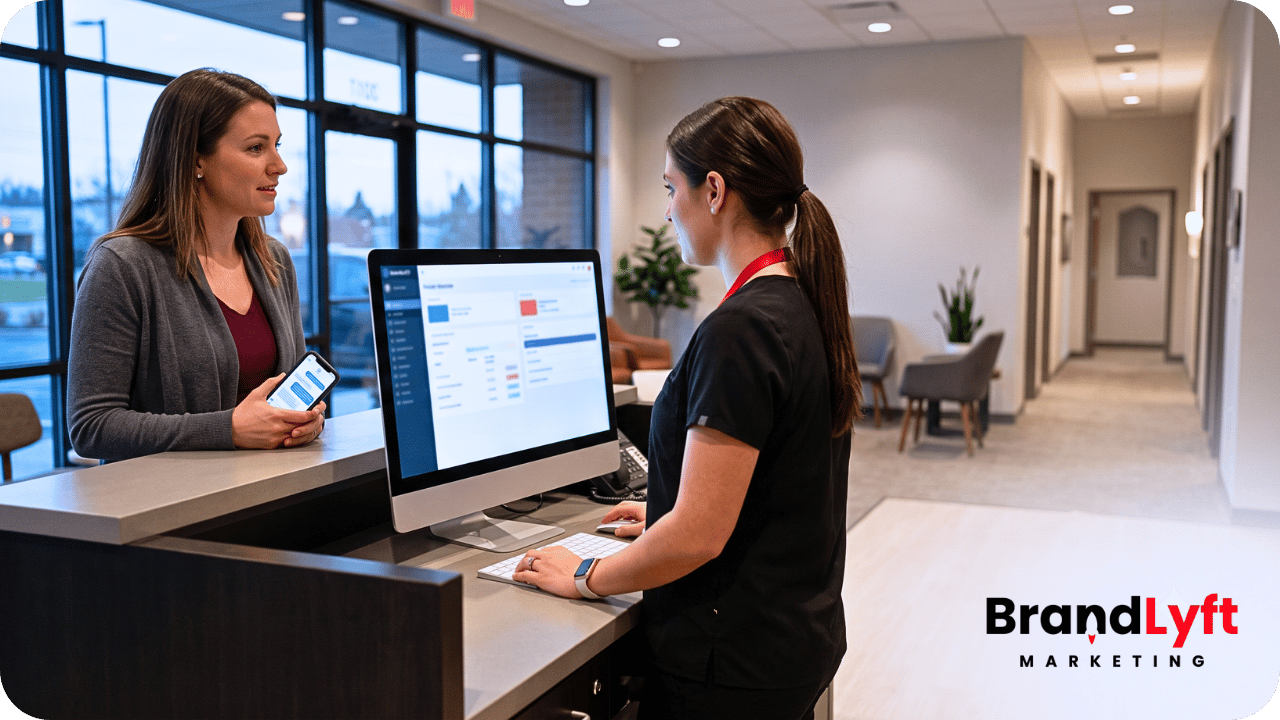
    AI chat with SMS follow-up transferring conversation context to a staff member at the correct practice location

    Pause the Bot When Staff Enters the Conversation

    A human takeover can fail when the bot keeps replying over the employee.

    Once a staff member accepts the handoff, automated answers should stop for the active conversation. Another contact message should not restart the bot while the employee is working the inquiry.

    Automation should return only after a deliberate status change, conversation close, or verified inactivity rule. A generic timeout can restart the bot too early.

    Staff should see whether the AI remains active, paused, or eligible to resume. Without that visibility, employees may hesitate to reply or assume the bot still owns the contact.

    Set an Honest Fallback When Nobody Is Available

    A multi-location practice should decide the availability promise before the widget goes live.

    “Talk to a person now” is inaccurate when the office only creates a next-day task. Use language that matches the real service:

    • Ask the team to follow up
    • Continue by text
    • Choose an appointment
    • Send this conversation to the practice
    • A team member will respond during these hours

    When nobody can take over, create a task, notify the correct location, preserve the transcript, keep the chosen channel open, and show the contact the next realistic step.

    BrandLyft’s Speed to Lead work applies when response timing, routing, and ownership need to function together. Faster messages do not help when the wrong location receives the task or nobody accepts it.

    Preserve Context Before the Staff Member Replies

    The employee taking over should not need to reconstruct the conversation.

    Give the staff member a compact handoff summary that includes:

    • Original question
    • Contact details already provided
    • Selected and eligible location
    • Requested service or appointment type
    • Preferred time
    • Current booking status
    • Chat and SMS history
    • Reason the AI requested help
    • Current owner
    • Expected next action

    The transcript remains useful, but staff should not have to read twenty messages to learn why the conversation reached them. A short summary should show what the AI asked, what the contact answered, and which promise the system made.

    Book Against the Correct Location and Appointment Type

    AI booking only works when calendar choices reflect real services, providers, hours, and locations.

    HighLevel supports multi-calendar booking in Conversation AI. The practice can map intent to different calendars and use fallback behavior when the request does not match cleanly.

    A fallback calendar should not silently offer the wrong service or office. When the AI cannot identify the correct calendar, it should ask a useful follow-up question or request human help.

    After booking, the same contact record should hold the location, appointment type, date, confirmation status, and any handoff notes. Rescheduling or cancellation should update that same path rather than create another conversation with no context.

    Test the Failures, Not Only the Happy Path

    A successful daytime booking proves very little.

    Test the full system with scenarios that expose identity, routing, consent, booking, and ownership problems:

    • New visitor during business hours
    • After-hours visitor
    • Visitor leaves before giving contact details
    • Contact declines or later revokes SMS permission
    • Invalid or undeliverable number
    • Wrong location or unavailable service
    • No suitable appointment time
    • Visitor asks for staff
    • Transfer target does not answer
    • Staff member accepts but never replies
    • Bot continues or resumes during human takeover
    • Existing contact stored under another location

    For every scenario, check the contact record, location, transcript, SMS status, appointment, owner, bot state, task, and final outcome.

    BrandLyft’s multi-location reporting article explains why total activity can hide local follow-up problems. The same issue applies here: a high number of AI replies does not prove that each location handled the inquiry correctly.

    When a Chat Widget Needs a Wider Build

    A standard widget may be enough when one location uses one calendar, one small team, and a simple set of approved questions.

    The build becomes harder with several locations, shared intake staff, external booking tools, duplicate-contact rules, webhook actions, or reporting across the full path.

    At that point, the work extends beyond chat configuration. BrandLyft’s Revenue System Build connects lead capture, routing, calendars, follow-up, ownership, and reporting. Practices already using HighLevel may need a deeper GoHighLevel Partner review when several workflows and location rules already overlap.

    AI chat with SMS follow-up should be tested as one intake path, not as separate chat, SMS, calendar, and staff tools.

    One Inquiry Should Not Become Four Separate Conversations

    The real test is not whether AI can answer one question on a website.

    The practice should follow the same inquiry after the visitor leaves the browser, changes location, continues by text, books, or asks for a person.

    AI chat with SMS follow-up works when contact identity, permission, location, appointment state, staff ownership, and conversation context survive every change. The contact should not need to begin again because the system changed channels.

    When Chat, SMS, Booking, and Staff Lose the Same Context

    Map the Intake Path Across Every Location

    Book a discovery call to discuss how the current website chat, texting, calendars, location routing, and human handoff fit together.

    Book the Intake Review

    Need the wider system connected first? Review Revenue System Build.

  • Elevating Client Engagement: How BrandLyft Marketing Maximizes Opportunities with LeadDragon’s “Missed Call Text Back

    Elevating Client Engagement: How BrandLyft Marketing Maximizes Opportunities with LeadDragon’s “Missed Call Text Back

    In modern marketing, responsiveness and immediate client engagement are the cornerstones of success. As a visionary marketing agency, BrandLyft Marketing understands that answering phone calls is not just a routine task—it’s a strategic move that can make or break a client’s perception of your brand. In this article, we explore the pivotal role of answering calls, shed light on the risks of disregarding missed opportunities, and unveil a transformative solution, LeadDragon’s “Missed Call Text Back” feature, which is set to redefine client interactions and drive exceptional growth for all our valued clients.

    The Power of Immediate Connections

    In a fast-paced digital era, the significance of swift, personalized communication cannot be overstated. BrandLyft Marketing recognizes that every unanswered phone call represents a potential missed opportunity. When clients and prospects reach out, they seek assurance, information, or solutions. By picking up the phone, we boldly state that their needs matter and are committed to delivering results.

    Missed Calls: A Costly Gamble

    Consider this scenario: a potential client discovers your brand, intrigued by the promise of your marketing prowess. They decide to give you a call, seeking insights about your services. The call rings, but there’s no answer. Frustration mounts and doubts creep in. In a split second, that potential client decides to explore other options—a competitor’s number is dialed, and a connection is established. The implications of a missed call can be catastrophic, causing clients to question our dedication and reliability.

    Unleashing LeadDragon’s “Missed Call Text Back”

    Enter LeadDragon’s revolutionary solution, the “Missed Call Text Back” feature—an instrumental tool that BrandLyft Marketing is proud to implement for all our clients. With this innovation, we transform missed calls from pitfalls into opportunities. Each unanswered call triggers an immediate and personalized text message, reassuring clients that their inquiries are valued and that we’re proactively working to cater to their needs.

    Elevating Engagement with AI-Powered Efficiency

    But the capabilities of LeadDragon don’t stop there. BrandLyft Marketing takes a giant leap forward by leveraging an AI-powered bot meticulously trained on our agency’s ethos and services. This digital assistant is a virtual extension of our team, addressing inquiries, scheduling calls, and providing real-time solutions while embodying our brand’s voice and commitment. Imagine having a tireless, 24/7 customer service and sales agent at your disposal—a feature that sets BrandLyft Marketing leagues ahead in client engagement.

    The BrandLyft Advantage: Driving Growth through Connection

    With LeadDragon’s “Missed Call Text Back” feature and our agency’s expert application, BrandLyft Marketing ensures that every interaction, no matter how brief, becomes a stepping stone toward stronger client relationships and elevated brand loyalty. Our commitment to answering calls encapsulates our dedication to success, innovation, and excellence.

    Embrace the Future of Engagement

    In the realm of marketing, first impressions are everything. BrandLyft Marketing is revolutionizing how we engage with clients, harnessing the power of LeadDragon’s technology to transform missed calls into meaningful connections. As we implement the “Missed Call Text Back” feature for all our clients, we’re setting a new standard for responsiveness and client satisfaction, reaffirming our position as a trailblazing marketing agency that values every moment of client interaction.

    Join us in embracing the future of engagement. Connect with BrandLyft Marketing, and together, let’s elevate your brand’s journey to unparalleled heights.

  • How AI Transforms the Marketing Funnel: Leading Human Buyers

    How AI Transforms the Marketing Funnel: Leading Human Buyers

    [vc_row][vc_column][vc_column_text woodmart_inline=”no” text_larger=”no”]Artificial intelligence (AI) is revolutionizing various industries in today’s digital landscape, and marketing is no exception. AI has the potential to transform the traditional marketing funnel by leading human buyers through each stage with enhanced personalization, proactive assistance, and streamlined processes. Let’s explore in greater detail how AI is reshaping the marketing funnel and empowering consumers to make informed decisions.

    Stage: Awareness

    DetailTodayNear-TermMid-Term
    AI EducationAI assists in responding to human prompts and queries.AI proactively educates users based on their needs.AI anticipates users’ information needs before they ask.

    Today, AI already plays a crucial role in the awareness stage by assisting users in understanding their needs and pain points. Users can prompt AI with specific queries, and AI responds by providing relevant information and recommendations. However, the future holds even more exciting possibilities. In the near term, AI will become increasingly proactive in educating users. Instead of waiting for prompts, AI will proactively anticipate users’ information needs and provide valuable insights and suggestions. For instance, imagine an AI assistant that suggests a personalized diet plan based on your health data, offering information and guidance even before you ask for it. Looking further into the mid-term, AI will continue to evolve and refine its ability to anticipate users’ needs, providing tailored content and recommendations that align with their preferences and behaviors.

    Stage: Engagement

    DetailTodayNear-TermMid-Term
    User-Initiated DialogUsers prompt AI for detailed information about solutions.AI initiates dialogue with users, offering solutions proactively.AI proactively engages users, even before they seek help.
    Personal AssistanceAI assists in tasks like arranging travel itineraries upon request.AI autonomously takes on tasks like travel planning and coordination.AI assists users with personalized recommendations and actions.

    In the engagement stage, AI transforms how users interact with brands and solutions. Currently, users typically prompt AI for detailed information or assistance when they have specific questions or requirements. AI responds by providing relevant answers or solutions. However, the future of AI in engagement is more proactive and user-centric. In the near term, AI will take the initiative to engage users, initiating dialogue based on their preferences and potential needs. 

    This means that AI will respond to user queries and offer solutions before users even realize they need assistance. For example, imagine an AI assistant that proactively arranges a travel itinerary for your upcoming holiday, considering your preferences and providing recommendations even before you thought to seek help. Looking ahead to the mid-term, AI will evolve into personalized assistants that proactively engage users, offering tailored recommendations and actions to enhance their engagement and overall experience.

    Stage: Consideration

    DetailTodayNear-TermMid-Term
    Product ComparisonsHumans compare products and read reviews.Humans delegate product comparisons to AI.AI shops and auto-compares products on users’ behalf independently.
    AI as a Shopping AgentHumans rely on AI’s suggestions and recommendations.AI provides comprehensive suggestions and comparisons for purchasing.AI autonomously handles purchases, streamlining the entire process.
    Personalized RecommendationsAI offers recommendations based on user preferences and behavior.AI leverages vast datasets to deliver highly personalized product options.AI becomes a trusted shopping agent, making informed decisions on behalf of users.


    The consideration stage is crucial for users as they evaluate different products or services and make informed decisions. Traditionally, humans compare products, read reviews, and rely on their research to make choices. However, with the advancements in AI, this stage is set to undergo a significant transformation. 

    In the near term, users will delegate the task of product comparisons to AI agents. Instead of manually sifting through multiple options, AI will leverage its ability to process vast amounts of data and provide users with comprehensive product comparisons based on their preferences and requirements. This will enable users to make more informed decisions efficiently. Looking into the mid-term, AI will take this transformation further by independently shopping and auto-comparing products on users’ behalf. AI agents will provide recommendations and autonomously handle purchases, streamlining the entire process and ensuring a seamless user experience.

    Stage: Purchase

    DetailTodayNear-TermMid-Term
    AI-enabled E-commerceUsers manually select and purchase products through websites.AI apps progressively handle purchases on users’ behalf.AI autonomously manages purchases, ensuring a seamless experience.


    In the purchase stage, AI will progressively take on a more active role, making the buying process smoother and more efficient for users. Today, e-commerce transactions primarily occur through websites and online retailers, with users manually selecting and purchasing products. However, AI apps will gradually become the preferred purchase platform in the near term. 

    Users will rely on AI agents to handle investments on their behalf, allowing for a more streamlined and personalized shopping experience. For example, imagine receiving a message from your AI assistant saying, “I’ve placed an order for your favorite brand of coffee.” The AI assistant will proactively track users’ preferences, manage inventory, and ensure a hassle-free transaction process. Looking ahead to the mid-term, AI will further evolve as a trusted shopping agent, making informed decisions on behalf of users, managing loyalty programs, and optimizing the overall purchase experience.

    AI is revolutionizing the marketing funnel by leading human buyers through each stage with enhanced personalization, proactive assistance, and streamlined processes. From creating awareness and engaging users to aid in consideration and streamlining purchases, AI transforms how consumers interact with brands and make purchasing decisions. As AI evolves, marketers and businesses must embrace this transformative technology to stay ahead in the competitive landscape and deliver exceptional customer experiences.

    At BrandLyft Marketing, we pride ourselves on being at the forefront of the ever-evolving marketing landscape, particularly when it comes to harnessing the power of AI. With our unwavering commitment to innovation and staying ahead of the curve, we have positioned ourselves as pioneers in leveraging AI to transform the marketing funnel and engage human buyers in groundbreaking ways. Our team of experts is constantly exploring cutting-edge AI technologies and staying abreast of industry trends to ensure that our clients benefit from the most advanced strategies and tactics. By embracing AI and its transformative potential, we empower businesses to connect with their target audience on a deeper level, deliver personalized experiences at scale, and achieve unprecedented levels of success. At BrandLyft Marketing, we are dedicated to revolutionizing the marketing landscape through AI, empowering our clients to lead the way in engaging human buyers and driving remarkable business growth.[/vc_column_text][/vc_column][/vc_row][vc_row][vc_column][html_block id=”6068″][/vc_column][/vc_row]